


Cbd Story
0102030405
What Can CBD Powder Be Used For? Three Key Applications of High-Purity CBD Raw Material — From Cosmetics to Beverages
2026-10-20
Many buyers of CBD raw materials ask the same question when they first receive that bag of white powder: What can this actually be used for?
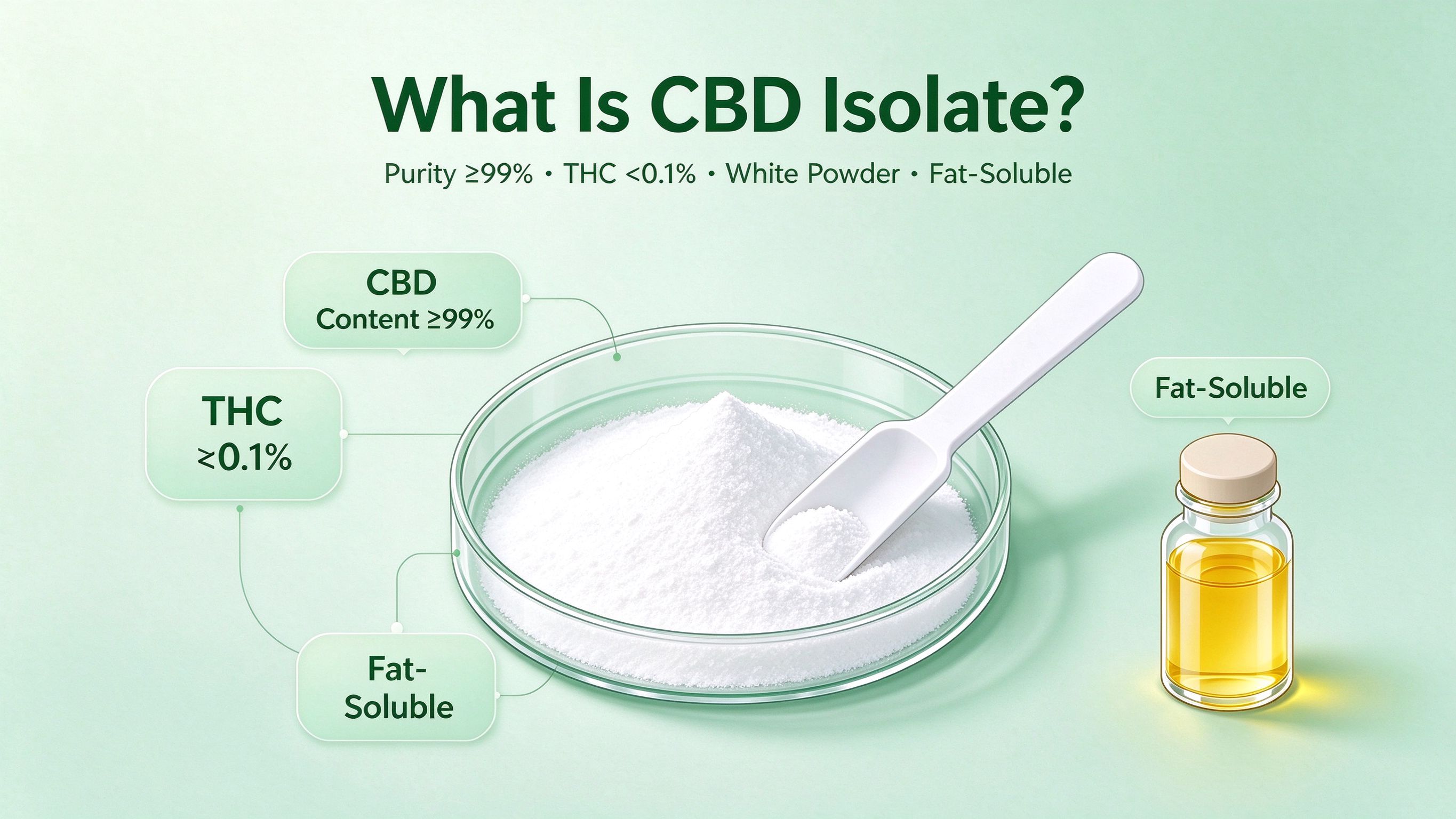
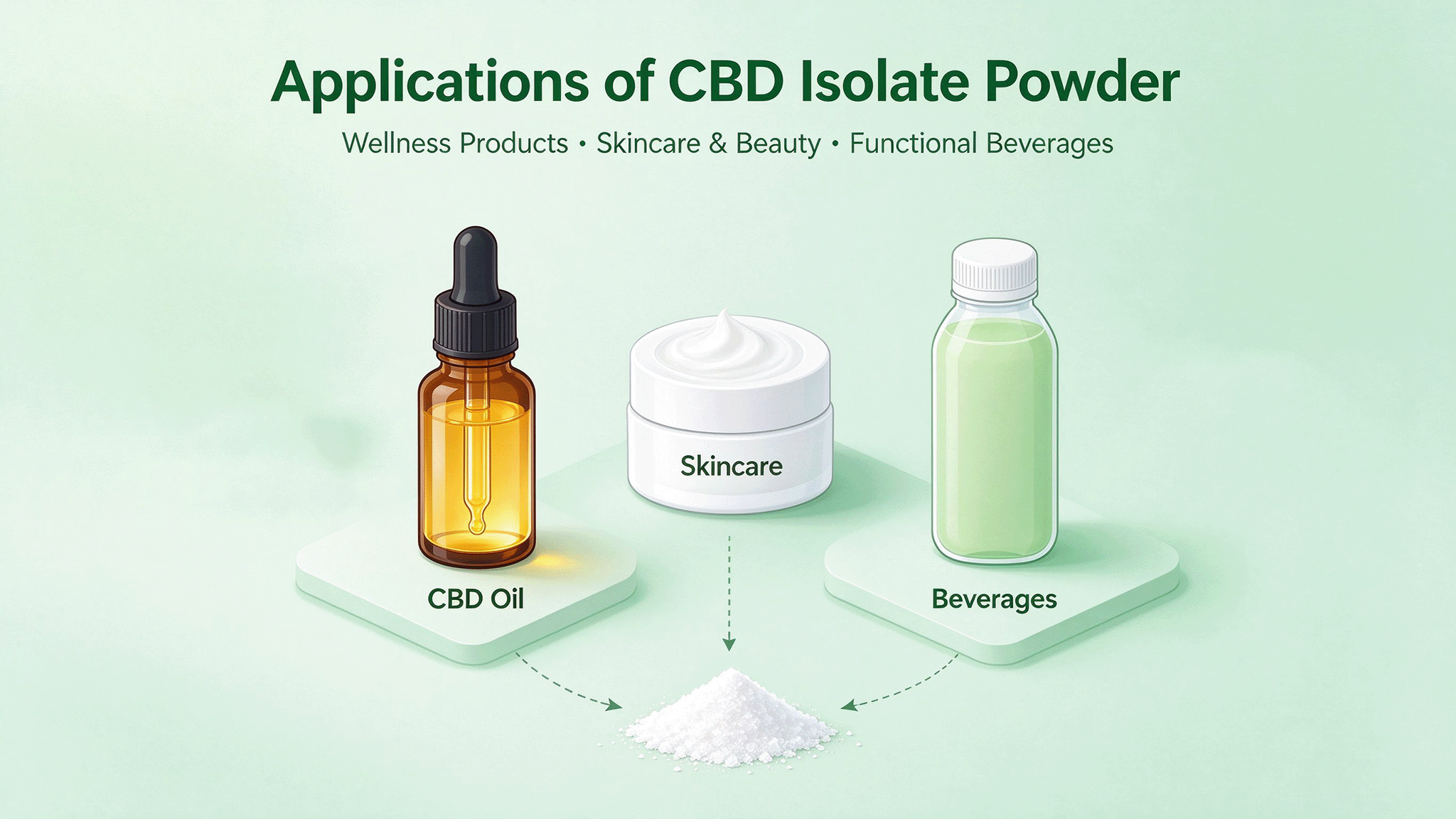
CBD powder (Cbd Isolate Powder) is essentially high-purity CBD monomer — a white crystalline powder with a CBD content of ≥99% and THC controlled below 0.1%. It is not a finished product itself, but a foundational ingredient for downstream formulations. Below, we outline the three most common application directions and the key points to consider when selecting raw materials for each scenario.
Application 1: Health & Wellness Products — The Most Mature Use Case
The most established application of CBD powder is as a base ingredient in various health and wellness products.
The most typical example is CBD oil: CBD powder is pre-dissolved in a carrier oil (such as MCT oil or Hemp seed oil) to produce the familiar CBD oil tinctures. The same principle applies to capsules — precise filling ensures consistent dosing. CBD powder can also be incorporated as a formulation ingredient into functional foods.
The core requirement for raw materials in this category is batch-to-batch stability. Health and wellness products demand dosage consistency, so CBD content must not fluctuate from batch to batch. When sourcing, focus on two things: whether CBD content can consistently reach 99% or above, and whether THC levels remain reliably below 0.1%. Passing sample testing is just the baseline — consistent stability across large-scale production batches is what truly matters.
Application 2: Skincare & Beauty — Highest Demands on Sensory Quality
Skincare and beauty products represent another major outlet for CBD raw materials, commonly used in formulations for creams, serums, body lotions, and similar products.
This application places exceptionally high demands on the "purity" of the raw material. CBD powder must be pure white and free of any residual solvent odor, so that it does not affect the color or scent of the final formulation. If the raw material has discoloration or solvent residue, the appearance and skin feel of the end product will be compromised.
Additionally, CBD powder is fat-soluble, so it typically needs to be pre-dissolved in an oil-based matrix (MCT oil and hemp seed oil are commonly used) for skincare formulations. From a processing standpoint, it is advisable to avoid prolonged exposure to temperatures above 80°C to better preserve active ingredients.
Application 3: Functional Beverages — Requiring Water-Soluble Conversion
CBD powder is inherently fat-soluble and cannot dissolve directly in water. To enter the beverage category, an additional conversion step is required — transforming it into water-soluble CBD.
By processing high-purity CBD powder through specialized techniques into a water-soluble form, it can be directly blended into aqueous systems. This enables applications such as CBD sparkling water, sports recovery drinks, functional bottled water, as well as instant solid beverages like coffee creamers, instant tea powders, and meal replacement shakes. It can even be used in oil-free personal care products such as toners and shampoos.
Water-soluble CBD has specific指标 requirements for dispersibility, heat stability, and pH stability (performing best in the pH 4.0–8.0 range). If you are planning beverage or water-based formulations, you can opt for the water-soluble form directly, eliminating the need for in-house conversion.
Selection Guide: Define Your Product First, Then Choose Your Raw Material
So, back to the opening question — what can CBD powder be used for? The answer depends on your product positioning:
- Oils, capsules, and food products → Choose standard CBD powder (≥99%, THC <0.1%)
- Skincare creams and serums → Choose high-purity white powder, with emphasis on color, odor, and batch consistency
- Beverages and water-based products → Choose water-soluble CBD, and verify dispersibility and pH compatibility
- Export to markets with strict THC regulations → Consider low-THC grade (THC <10ppm), subject to local regulations
Raw material is only the starting point. What products CBD powder can go into — and how well it performs — depends on your formulation, processing, and compliance design. This is precisely why, when selecting a supplier, you should look beyond purity and assess whether they can deliver consistently and provide fully traceable data.
In short: CBD powder is a "versatile building block," but what product it ends up in — and how well it works — comes down to your formulation and the strength of your supplier.